 EN EN
EN EN Explore our top-rated OEM/ODM export products engineered for global pet food brands, supermarkets, and B2B distributors.
The global feline hygiene and pet care market is undergoing a seismic shift. As urban household pet ownership accelerates across North America, Europe, Asia-Pacific, and the Middle East, commercial buyers—ranging from regional retail chains and e-commerce brand owners to multinational pet product importers—face unprecedented challenges in securing high-performance, cost-effective, and ecologically sustainable cat litter supplies. China has solidified its position as the undisputed powerhouse of global cat litter manufacturing, accounting for over 60% of the world's processed sodium bentonite exports and dominating the technological innovation space for plant-based biodegradable alternatives such as tofu, cassava, and green pea fiber cat litters.
Navigating the complex landscape of Chinese suppliers, mineral mines, private-label OEM factories, and international shipping protocols requires deep technical insight and strategic foresight. This authoritative whitepaper provides global procurement managers with an exhaustive evaluation framework for evaluating mineral extraction purity, dust-elimination processing technologies, moisture-absorption kinetics, structural clump integrity, and corporate sustainability metrics.
Core Procurement Insight: The difference between tier-1 mineral exporters and low-cost traders lies in vertical integration. Controlling the supply chain from raw mineral extraction (mine-site level) down to automated de-dusting and secondary packaging guarantees batch consistency, zero structural decay during ocean transport, and compliance with strict Western pet safety standards.
Understanding the chemical and structural composition of raw materials is vital for negotiating technical specifications with manufacturers. Cat litter products exported from China primarily fall into two core mineral and organic categories: Montmorillonite-rich sodium bentonite clays and engineered plant-derived biopolymers.
Natural sodium bentonite is a soft phyllosilicate alumino-silicate clay formed millions of years ago from volcanic ash weathering. Its fundamental crystal structure consists of two-dimensional sheets of silica tetrahedra sandwiching a central alumina octahedron (a 2:1 layer lattice structure). The presence of exchangeable sodium cations (Na+) between these interlayer sheets endows natural sodium bentonite with extraordinary water-swelling capacity—expanding up to 15 to 20 times its dry volumetric state when exposed to feline urine.
In contrast, calcium bentonite possesses calcium cations (Ca2+) within its interlayer. It exhibits lower swelling dynamics (typically 2 to 5 times) and forms weak, crumbly clumps that break during scooping. High-end China exporters utilize premium sodium bentonite deposits mined primarily in Inner Mongolia, Liaoning, and Shandong provinces. Tier-1 manufacturers implement chemical sodium modification (sodification) on calcium clay only when natural sodium reserves are restricted, ensuring high cation exchange capacity (CEC > 70 meq/100g) for rapid hydraulic sealing and rock-hard clump formation.
The modern eco-conscious consumer segment demands 100% biodegradable, flushable, and non-toxic litters. Chinese manufacturers have pioneered the transformation of agricultural processing byproducts—specifically food-grade yellow pea fibers and cassava (tapioca) root starches—into ultra-absorbent cat litters.
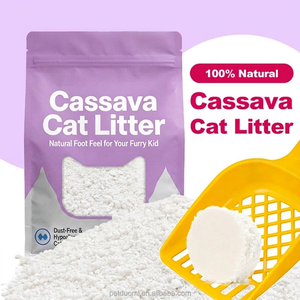
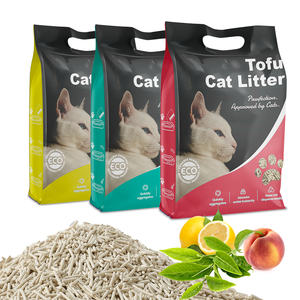
Pea fiber tofu litter utilizes food-grade insoluble plant cellulose strands extruded under high pressure and temperature into uniform cylindrical pellets (typically 1.5mm to 3.0mm diameter). When liquid strikes the pellet surface, the insoluble fiber lattice traps liquid through capillary action, while cross-linked corn or guar gum binder agents rapidly hydrate to fuse adjacent pellets into a tight, liftable disc. Cassava cat litter leverages the high amylopectin starch content of cassava roots to deliver instantaneous gelation, forming rock-hard clumps without synthetic chemical adhesives.
| Substrate Type | Primary Material Origin | Absorption Ratio (w/w) | Clump Hardness (N) | Dust Index (%) | Eco/Flushability Profile |
|---|---|---|---|---|---|
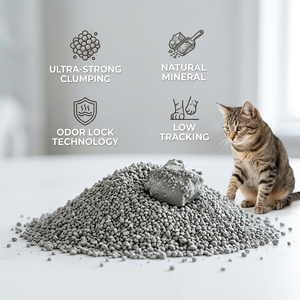
| Natural Sodium Bentonite | Mining Deposits (Liaoning/Inner Mongolia) | 250% - 350% | > 18 N (Rock Hard) | < 0.1% (4-stage dust removal) | Landfill Safe / Non-flushable |
| Standard Tofu Litter (3.0mm) | Food-grade Pea Fiber & Corn Starch | 300% - 400% | 12 N - 15 N | < 0.05% (Virtually Dust-Free) | 100% Flushable & Compostable |
| Micro Tofu Litter (1.5mm) | Refined Pea Powder & Guar Gum | 400% - 450% | 15 N - 17 N | < 0.05% | Rapid Flush / High Solubility |
| Hard Granule Cassava | Natural Cassava Root Starch | 450% - 600% | > 20 N (Instant Gel) | < 0.08% | Flushable & 100% Biodegradable |
| Hybrid Bentonite-Tofu Mix | 70% Bentonite + 30% Tofu Granules | 320% - 420% | 16 N - 19 N | < 0.1% | Semi-Flushable / Optimized Cost |
Raw mineral extraction is merely the first link in the value chain. To produce export-quality pet hygiene products that meet the stringent demands of international retail brands, leading Chinese factories employ advanced processing technologies designed to maximize functional performance while eliminating consumer pain points.
Feline respiratory health and home cleanliness depend heavily on dust reduction. Poorly processed bentonite or plant litters release microscopic airborne particles (PM2.5 and PM10) when poured into litter boxes, triggering asthma or eye irritation in sensitive cats and owners. Top-tier manufacturers incorporate a multi-stage de-dusting system during processing:
Controlling volatile organic compounds (VOCs) and ammonia gas ($NH_3$) generated by urease-producing bacteria is the primary benchmark of cat litter efficacy. Leading OEM manufacturers utilize dual-action odor mitigation strategies:
1. Molecular Inclusion & Porous Adsorption: Activated carbon micro-particles (with specific surface areas exceeding $1,000 m^2/g$) and natural zeolites are blended directly into clay matrix formulas. Their porous physical lattice permanently traps foul-smelling mercaptans and hydrogen sulfide gases.
2. Antimicrobial Spraying & Enzyme Inhibition: Substrates are treated with non-toxic silver ion ($Ag^+$) complexes or botanical antibacterial agents (such as tea polyphenols). These agents inhibit bacterial cell membrane division, preventing the enzymatic breakdown of urea into volatile ammonia gas over prolonged 30-day usage cycles.
Strategic sourcing managers must anticipate market developments to maintain competitive advantage. Our research highlights four transformative trends driving global pet care purchasing decisions over the coming decade:
Market demand is shifting rapidly from traditional 3.0mm tofu pellets to 1.5mm micro-pellet formulations and 70/30 Bentonite-Tofu hybrids. These engineered blends deliver the familiar sandy texture cats instinctively prefer alongside the flushable, low-dust benefits of plant fiber.
Freight costs and retail shelf weight constraints are accelerating adoption of lightweight mineral litters. Utilizing ultra-porous expanded attapulgite and engineered bentonite compounds, these products offer up to 40% density reduction per liter compared to standard clay, slashing bulk ocean shipping fees.
Smart, functional litters containing color-changing pH indicator granules represent the highest-margin premium category growth. These granules change color to signal feline urinary tract infections (FLUTD), metabolic alkalosis, or hematuria before clinical symptoms manifest.
When evaluating Chinese suppliers, international buyers must look beyond trading intermediaries to partner directly with mine-to-shelf manufacturers. Sepicat and our strategic manufacturing alliance leverage over 35 years of dedicated mineral extraction and pet hygiene production experience.
By directly owning and operating bentonite mining reserves and processing facilities, our manufacturing partner controls raw material purity from the moment clay is extracted. This vertical integration guarantees complete raw material traceability, protects against price volatility in external mineral markets, and ensures batch-to-batch consistency across multi-container purchase orders.
We provide turnkey OEM and ODM solutions for global brand owners, offering flexible packaging configurations:
Leading Chinese exporters must operate with strict adherence to environmental regulations and social accountability. Our production facilities maintain ISO9001 quality management, ISO14001 environmental management, and BSCI social compliance certifications. Furthermore, our enterprise commitment extends to animal welfare, having donated over 150,000 liters of high-performance cat litter to animal rescue shelters and non-profit welfare organizations worldwide.
Answers to common commercial, logistical, and technical questions regarding wholesale cat litter sourcing from China.
Our standard MOQ for custom private-label packaging (printed bags) is one 20-foot full container load (FCL), which typically holds 18 to 24 metric tons depending on product density (e.g., ~24 tons for sodium bentonite clay or ~14 tons for vacuum-packed tofu litter). For standard unprinted bags or existing stock packaging, lower trial quantities can be accommodated upon request.
Every production batch passes through our proprietary 4-stage negative-pressure cyclonic dust removal system and electrostatic vacuum filtration. Prior to container loading, quality control technicians perform standardized particle sieve testing to ensure residual dust content remains strictly below 0.1% for clay litters and below 0.05% for plant-based tofu litters.
When stored in a dry, ventilated warehouse inside original sealed packaging, mineral bentonite cat litter has an indefinite shelf life. Plant-based tofu and cassava litters have a recommended shelf life of 24 months. Our vacuum-sealed packaging prevents humidity ingress during long ocean transportation across tropical maritime routes.
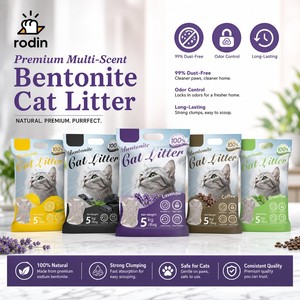
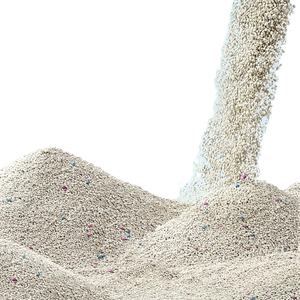
Yes. We offer fully customizable fragrance options including Lavender, Baby Powder, Green Tea, Apple, Coffee, and Peach. We utilize imported food-grade fragrances encapsulated in slow-release micro-beads. Additionally, we can integrate active ingredients such as activated carbon, blue/pink silica gel beads, or antimicrobial silver ions to match your brand's unique market positioning.
For initial OEM orders requiring custom bag printing and plate making, production lead time is typically 15 to 20 days after artwork confirmation. Repeat orders are produced within 10 to 14 days. Ocean transit times vary by destination port (e.g., 12–15 days to US West Coast, 25–35 days to European main ports).
Absolutely. We provide free sample kits (containing bentonite granules, tofu pellets, or cassava formulas) for physical performance evaluation, clump hardness measurement, and absorption testing. Interested international buyers only cover international courier shipping fees, which are fully refunded upon placement of the first official container order.
Connect directly with China’s premier vertically integrated mineral extraction and pet hygiene manufacturing experts. Get custom factory pricing, technical specifications, and free sample packs today.
Send an Inquiry