 EN EN
Natural Cat Litter now includes more than one simple alternative to clay. Global buyers can choose from plant-based materials such as wood, paper, corn, wheat, grass, and tofu by-products. Each behaves differently in the tray. Some wood pellets soften when wet, while many corn- or wheat-based litters form clumps that are easier to scoop. Paper products may feel gentler under sensitive paws, but their absorbency and odor control vary by formulation.
Those differences matter in real homes and across supply chains. A fine litter may track onto a hallway rug; a dusty one can leave a visible film near the box. Moisture resistance, bag strength, storage conditions, and shipping weight also affect the buying decision. Product labels and supplier specifications can help, but buyers should check what “natural,” “flushable,” or “biodegradable” means for each product and market. Claims are not always equally clear.
A sample test helps. Pour a small amount into a clean tray and observe dust, clumping, odor, and cleanup over several days. Cat preference matters, too; a technically impressive product is of little use if a cat refuses it. No material wins on every measure. Even a thoughtful comparison can miss how a litter performs in a humid warehouse or a busy household. This guide examines leading natural litter types, their practical trade-offs, and the questions global buyers can ask before placing an order.
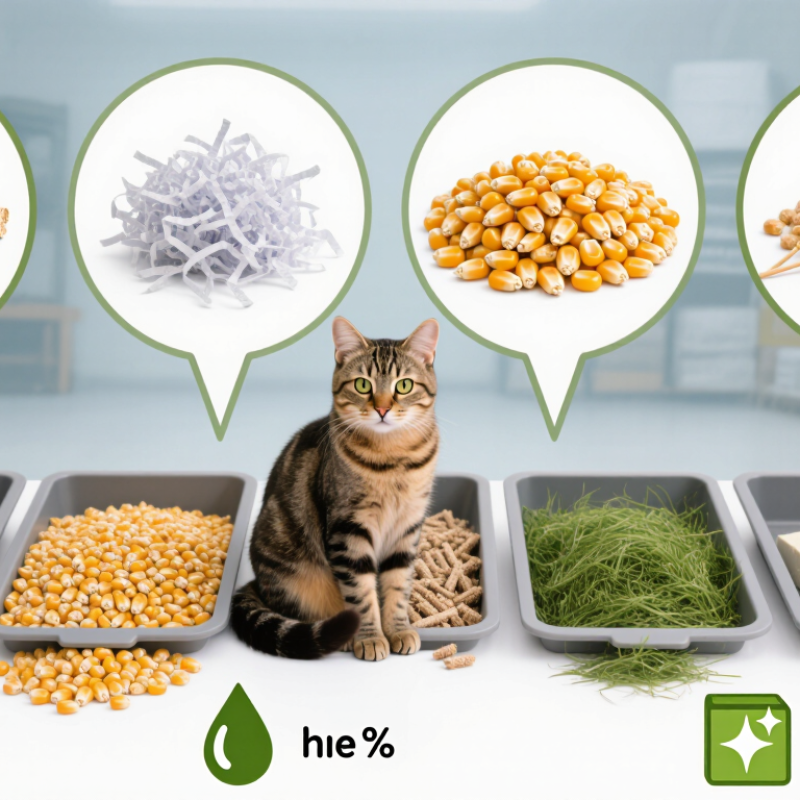
Natural cat litter describes products made mainly from minerals or plant-based materials, but the term has no single production standard. Clay litter is typically mined, dried, crushed, and screened into granules. The U.S. Geological Survey’s Mineral Commodity Summaries 2024 estimates U.S. bentonite production at about 4.6 million tons in 2023. That figure covers all uses, not cat litter alone. That distinction matters.
Plant-based litter may use wood, paper, corn, wheat, or other fibers. Manufacturers usually clean and dry the feedstock, then mill it into particles or press it into pellets. Some products also contain binders or odor-control additives, so “natural” does not mean unprocessed or additive-free. Buyers should check ingredient disclosures and compare particle size, dust, absorbency, and disposal guidance. A handful of litter can reveal texture and dust better than a product description.
Material origin alone does not prove lower environmental impact. Mining, drying, transport, and packaging all matter, and comparisons depend on the product and supply chain. Not automatically greener. Plant fibers may come from useful by-products, but that advantage can vary; even the word “biodegradable” needs context. Ask suppliers for documented composition and test methods, rather than relying only on broad natural claims.
| 2026 Top Natural Cat Litter Types for Global Buyers - What Defines Natural Cat Litter and How Is It Made? | |||||
|---|---|---|---|---|---|
| Litter Type | Typical Raw Material | How It Is Made | Clumping and Odor Control | Key Advantages | Buyer Considerations |
| Natural cat litter: definition | Plant, wood, paper, or naturally occurring mineral materials | Materials are processed into granules, pellets, flakes, or absorbent fibers. Processing may include drying, milling, screening, pelletizing, and heat treatment. | Performance depends on the material and formulation; “natural” does not by itself indicate clumping ability or odor control. | Can describe products made from renewable plant-based inputs as well as mined minerals. | The term is not a guarantee of biodegradability, compostability, chemical-free status, or a particular environmental impact. Check the ingredient list and disposal guidance. |
| Wood and pine | Sawdust, wood shavings, or other wood-processing by-products | Wood is dried and screened; some products are compressed into pellets. Pellet litter may break down into finer sawdust when wet. | Usually non-clumping in pellet form, though wood-fiber products vary. Wood scent may help mask odors; regular removal of soiled material is still needed. | Uses wood-based feedstock and is available in pellet and granular formats. | Dust, scent, pellet size, and absorption vary. Confirm the wood species, any added fragrance, and the recommended disposal method. |
| Recycled paper | Recycled paper fibers | Paper is pulped or shredded, then formed into absorbent pellets or granules and dried. | Generally non-clumping; absorbs moisture, while odor control depends on product design and cleaning frequency. | Uses recovered paper fiber and is often available in low-tracking pellet formats. | Check pellet softness and size, moisture absorption, and whether the product contains added deodorizing ingredients. |
| Corn | Corn kernels, corn fiber, or other corn-derived material | Plant material is dried and milled, then processed into granules or pellets; some formulas use starch to help bind clumps. | Many products are designed to clump, but clumping strength and odor control differ by formula. | Plant-based and commonly offered in lightweight, clumping formats. | Keep dry and store securely. Check for fragrance or other additives, and follow the label’s disposal instructions rather than assuming it is flushable or compostable. |
| Wheat | Wheat grain, bran, or other wheat-derived material | Wheat material is dried and milled into granules; natural starches may help bind moist litter into clumps. | Often formulated to clump. Odor control and clump firmness vary across products. | Uses an agricultural plant-based feedstock and can be made in familiar granular formats. | Consider grain or dust sensitivities in the household, keep the product dry, and review ingredient and disposal information. |
| Walnut shell | Ground walnut shells, often from shell-processing by-products | Shells are cleaned, dried, ground, and screened into granules of selected sizes. | Some products clump; absorption and odor performance depend on particle size and formulation. | Makes use of a hard plant material that may otherwise be a processing by-product. | Not suitable for households where walnut allergy is a concern unless the manufacturer provides clear, relevant safety information. Check dust levels and disposal guidance. |
| Tofu or soy-fiber | Often soy pulp (okara) or other plant fibers; formulations vary | Fiber is dried and processed, commonly with starch or other binders, then extruded or formed into small pellets. | Frequently designed to clump. Clump strength, dust, and odor control vary by ingredients and manufacturing process. | Lightweight plant-fiber formats are widely available, including fine and pellet-style products. | “Tofu litter” does not always mean a single, standardized ingredient. Read the full composition and do not flush unless local plumbing guidance and the product label explicitly allow it. |
| Grass seed or grass fiber | Grass seed or processed grass-derived fiber | Plant material is dried, milled, and shaped into granules; some products use natural or added binders. | Some formulations clump, while others absorb without forming firm clumps. Odor control is product-specific. | Plant-based and often relatively lightweight compared with dense mineral litter. | Compare dust, tracking, ingredients, and supply consistency. Crop origin and processing can affect the final product. |
| Bentonite clay | Naturally occurring sodium or calcium bentonite clay | Clay is mined, dried, crushed, and screened into granules. Sodium bentonite is commonly used for its swelling and clumping behavior. | Typically forms firm clumps when made with clumping-grade bentonite; odor control depends on the product and routine maintenance. | Reliable clumping performance and broad availability in many markets. | It is naturally occurring but mined and not plant-based. Consider mining impacts, package weight, dust, transport emissions, and disposal requirements. |
| Silica gel crystals | Porous silica, a mineral-based material | Silica is processed into porous granules or crystals designed to absorb moisture. | Usually non-clumping; crystals absorb moisture, while solids must be removed regularly. | Lightweight formats are available and some products can remain usable longer than conventional non-clumping litter, depending on use and care. | Mineral-based rather than plant-based or biodegradable by default. Follow the product’s replacement schedule and disposal instructions. |
| Practical comparison note: “Natural” is a broad product description, not a uniform performance or environmental standard. For global sourcing, compare ingredient disclosure, particle size, dust, clumping behavior, packaging, country-specific import requirements, and locally permitted disposal methods. Do not flush cat litter or compost used litter unless local authorities and the product label specifically permit it. | |||||
Common options include wood, recycled paper, corn, wheat, walnut shells, grass, and soybean pulp. Each feels different.
Wood pellets may control odors when kept dry, but wet pellets break into sawdust. Paper is soft and often low-dust, though it may need frequent changing. Not always convenient.
Corn, wheat, and some plant-fiber blends can clump well. Humidity may change their texture and odor control, so test them in the intended home.
Compare the amount used per week, not just the bag price. Track scooping, odor, and bag use for two weeks. Real household use can surprise you.
Request details on materials, granule size, moisture, dust, and packaging weight. Samples from multiple batches can reveal changes in color or texture.
Use the intended tray depth, room ventilation, and cleaning routine. Watch for dust while pouring, then check tracking and odor over several days. A quick test can miss issues.
Ask about minimum order quantities, production lead times, pallet dimensions, and moisture protection. Freight and storage conditions can affect the final cost and product condition.
Some cats reject a sudden change. Introduce the new texture gradually, and observe whether your cat uses the tray comfortably. Small details matter.
Natural Cat Litter is made from plant-based, mineral, or recycled materials, processed into granules or pellets designed to absorb moisture and control odor. Common options include wood, paper, corn, wheat, grass, tofu, and natural clay alternatives. Each type offers a different balance of clumping ability, dust levels, weight, odor control, availability, and price, so performance should be assessed against the needs of cats and the practical requirements of buyers.
When comparing products, buyers should consider ingredient transparency, dust and fragrance levels, packaging, storage, and disposal instructions, as well as the environmental impact of sourcing and transport. For global purchasing in 2026, evaluating samples, checking product specifications, confirming consistent quality, and comparing total landed costs can help identify a suitable option. The best choice combines dependable performance and reasonable cost with clear safety information and responsible material sourcing.